
Integrated security for strata schemes, apartment complexes, townhouse and villa communities, gated estates and other large residential developments — designed around shared spaces, access patterns, residents, visitors and operating requirements.
Advent Security combines professional security personnel, electronic security, surveillance, monitoring and security consulting to help residential communities manage access, protect common property, improve visibility and respond to security events.
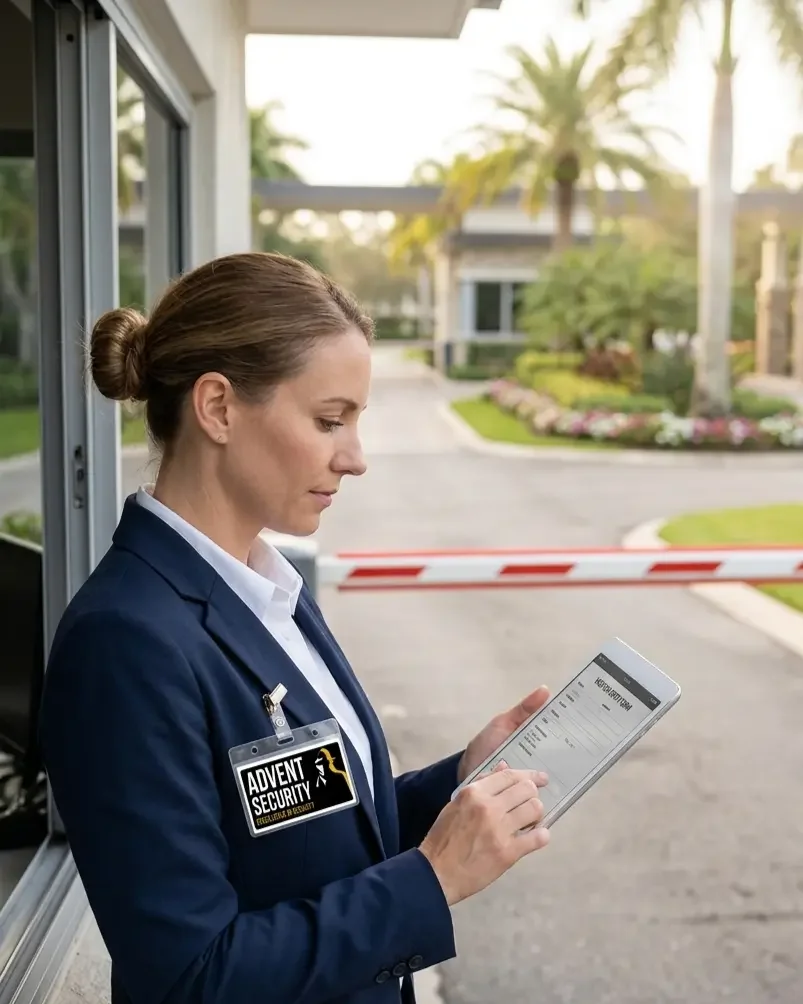
A single development may combine resident access, visitors, trades, deliveries, shared amenities, vehicle movements, garages, storage, plant areas, pedestrian routes and after-hours activity. Security needs to work as a coordinated operating environment rather than a collection of isolated devices.
Multiple people use the same entry points and facilities.
Controls to consider: Access control + intercom / visitor workflows + CCTV.
Different users need different access rights/timings.
Controls to consider: Role-based access + visitor management + contractor processes.
High-frequency movement can create blind spots, tailgating and access disputes.
Controls to consider: CCTV + access control + boom gates / LPR where appropriate.
Pools, gyms, clubhouses and rooms may need time-dependent access.
Controls to consider: Scheduled access + CCTV where appropriate + procedures.
Large communities have multiple boundary and movement points.
Controls to consider: Perimeter review + surveillance + patrol routes.
Incidents can occur outside building-manager hours.
Controls to consider: Monitoring + alarms + patrol/response pathways.
Legacy systems can create administrative gaps.
Controls to consider: Assessment + staged upgrade + integration.
Security must coexist with a welcoming environment.
Controls to consider: Discreet design / notices/governance + proportionate coverage.
Each card leads to a tailored conversation about your community’s risk profile, controls and next steps.
Multiple entries, roads, parking, amenities, perimeter.
Vehicle gates, pedestrian routes, perimeter.
Resident turnover, visitor flow, digital access.
Controls: Access control, intercom, CCTV, procedures.
Controls: Access control, intercom, CCTV, resident procedures.
Controls: Boom gates, access control, LPR, CCTV.
Controls: CCTV, access control, patrols, alarms.
Controls: Visitor management, intercom, concierge, procedures.
Controls: Scheduled access control, CCTV, procedures.
Controls: Alarms, CCTV, patrols, access procedures.
Controls: Audit, maintenance, staged upgrade, integration.
Controls: Recorded CCTV, access events, incident documentation.
Controls: Mobile patrols, monitoring, selective static coverage.
Different areas of a residential community require different controls. This map demonstrates the coordinated architecture across ten zones.
Define and monitor entry.
Example controls: CCTV, perimeter review, patrols, alarms
Control vehicle access and identify exceptions.
Example controls: Boom gates, access control, LPR, intercom, CCTV
Manage resident and visitor entry.
Example controls: Access control, intercom, visitor management, CCTV
Limit access to appropriate areas.
Example controls: Access control, CCTV where appropriate
Monitor vehicles and shared access.
Example controls: CCTV, access control, lighting review, patrols
Manage scheduled access.
Example controls: Access schedules, CCTV where appropriate, procedures
Protect shared assets.
Example controls: CCTV, access control, patrols
Restrict non-public access.
Example controls: Restricted access, alarms, audit trails
Support visibility and after-hours oversight.
Example controls: CCTV where appropriate, patrol routes, lighting review
Coordinate alerts and escalation.
Example controls: Monitoring, incident workflow, reporting
Every residential community has its own layout, access arrangements and operating requirements. Advent’s approach begins with understanding the site, identifying priorities and coordinating appropriate personnel, technology and procedures.
Understand the community layout, access points, shared spaces, operating patterns, existing systems and priorities.
Identify the people, assets, zones and operating points requiring the greatest level of control or visibility.
Build a proportionate architecture combining security personnel, technology and practical operating procedures.
Connect relevant systems and workflows so events can be detected, assessed and escalated through agreed pathways.
Install/configure approved controls, establish procedures, train relevant stakeholders and hand over documentation.
Maintain, monitor, review and improve the security environment as community needs change.
Visible professional presence for access management, patrols, incident support and community-facing security tasks where onsite coverage is appropriate.
Site-specific coverage for controlled entrances, gatehouses or operational posts where a consistent physical presence is required.
Scheduled or responsive mobile presence across larger communities, shared areas and perimeter routes.
Resident-facing front-of-house support combined with security responsibilities for visitor handling and access workflows where appropriate.
Strategic surveillance for entrances, car parks, paths, shared amenities, service areas and other priority zones.
Controlled, auditable access for residents, authorised users and restricted shared areas.
Support visitor, contractor and delivery access without turning every entrance into a manual process.
Detection and escalation arrangements for defined events and after-hours protection.
Automated vehicle-access controls and vehicle identification where appropriate to community layout and operating model.
Intelligent event detection / analysis where technology and environment support it.
Assessment and security planning before technology, patrol or guarding decisions are locked in.
Compatible physical, electronic and operational controls organised into one practical architecture.
A defined event is detected through a person, alarm, access-control event, CCTV/analytics or another approved control.
The event is assessed using available information and the community’s approved operating procedure.
The event is escalated according to the agreed response matrix, potentially involving onsite personnel, mobile patrols, management contacts or emergency services.
The incident is documented and, where appropriate, evidence and lessons are retained for investigation, reporting and improvement.
Use owners corporation / strata committee terminology; link to current NSW Government strata guidance.
Use owners corporation / committee terminology; link to current Consumer Affairs Victoria guidance.
Use body corporate / committee terminology for community titles schemes; link to current Queensland Government guidance.
Use strata company / strata council terminology where relevant; link to current Landgate guidance.
Placement, notices, recording, retention and access to footage can depend on the scheme and applicable law; link to current OAIC and state guidance.
Identify priority controls and discuss a practical, community-scale approach.
Residential communities can use a combination of CCTV, access control, intercoms, visitor management, alarms, monitoring, security guards, mobile patrols, gate controls and security consulting. The right combination depends on the community layout, access points, shared areas, operating model and existing systems.
Strata security can include common-area surveillance, access control, intercoms, visitor management, alarms, patrols, gate controls and security planning designed around shared property and community access requirements.
Security arrangements can be focused on common property, shared entrances, car parks, amenities, service areas, perimeter zones and other agreed community areas rather than individual apartments.
Compatible CCTV and access-control systems can be coordinated so that access events and surveillance information support a more complete security workflow.
Existing systems can be assessed to identify maintenance requirements, administrative gaps, upgrade priorities and opportunities for staged improvement or integration.
Visitor and contractor access can be supported through intercoms, visitor management, access control, concierge services and agreed community procedures.
Mobile patrols can provide scheduled or responsive presence across larger communities, shared areas, internal roads and perimeter routes.
Boom gates and license plate recognition can be used where appropriate to the community layout, vehicle access requirements and operating model.
Communities should consider camera placement, coverage, notices, recording, retention, access to footage, privacy requirements and the applicable governance and legal context.
Security consulting and risk assessment can help identify priorities, review existing controls and develop a practical security architecture before technology, patrol or guarding decisions are finalised.