
Protect goods, people, vehicles and critical operating areas with a security strategy designed around how your warehouse, distribution centre or logistics facility actually works.
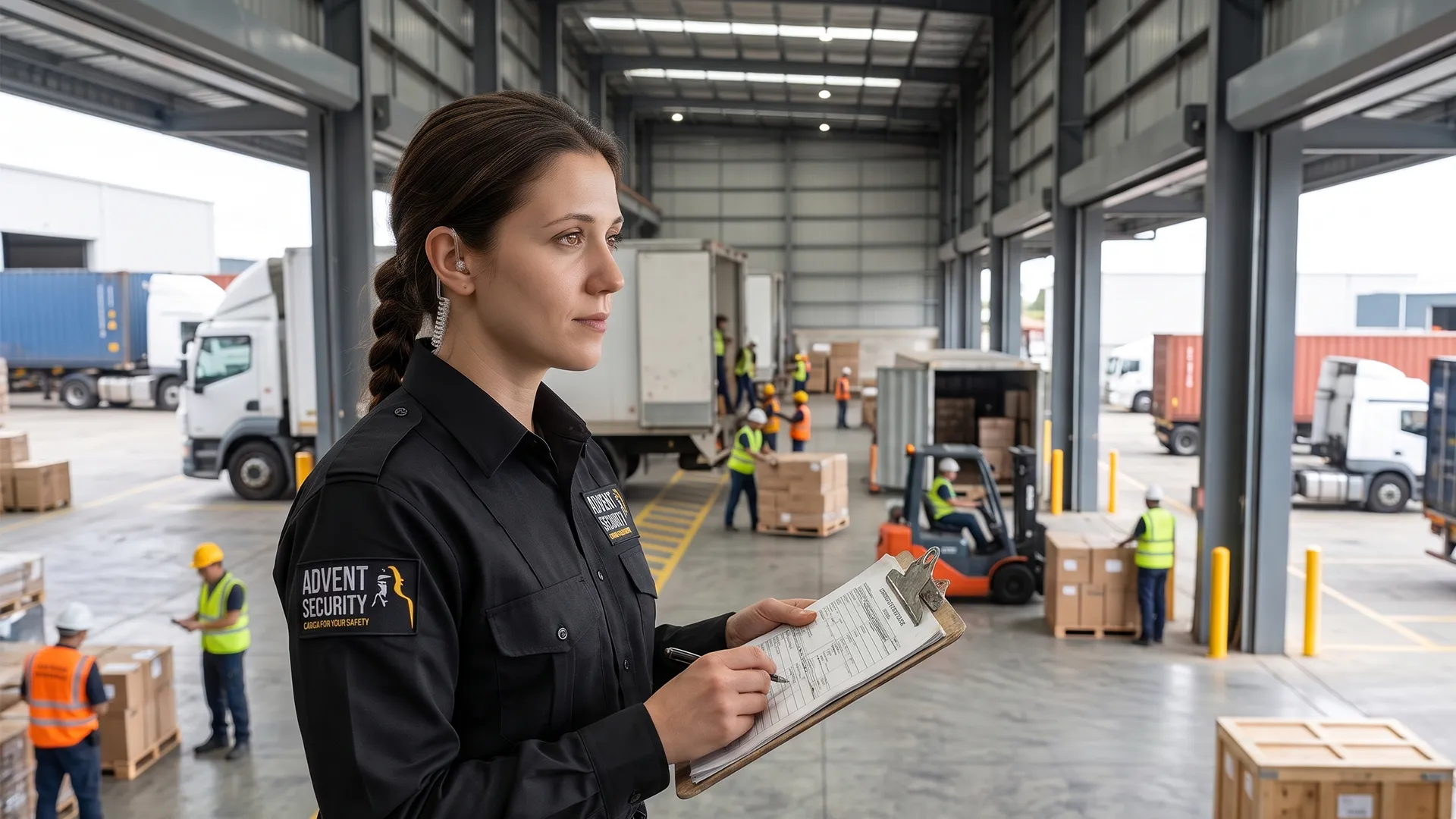
A warehouse or distribution centre is not a static site. Large perimeters, multiple vehicle and pedestrian entry points, loading docks, high-value stock, contractor movement and shift-based operations create security requirements that change throughout the day.
Effective warehouse security therefore needs to work across the full operating cycle — from gatehouse and receiving through storage and dispatch, to shift changeover and after-hours activity.

Advent designs security around the actual movement of people, vehicles and goods across your site.
Control who and what enters the site, with appropriate security procedures and access controls.
Manage vehicle and pedestrian movement around loading, unloading and dispatch operations.
Support visibility and control across vehicle staging, parking and external operating areas.
Protect restricted areas, high-value stock and sensitive storage zones.
Maintain visibility across inbound and outbound goods, vehicles and people.
Extend security coverage when the site is quiet through monitoring, alarms and agreed response procedures.
Security personnel, electronic security and security management should not operate as isolated functions. The right architecture connects the controls that matter to the way the facility operates.
Presence, access checks, observation, incident handling.
Coverage of gates, docks, yards, storage and defined risk areas.
Manage authorised access to people and vehicles where appropriate.
Identify defined security events and provide agreed alerts.
Assess events and follow agreed escalation procedures.
Use incidents and observations to refine the security model.
Security personnel can support access procedures, driver/visitor processing, site rules and incident escalation where required.
Commercial CCTV coverage designed around entrances, loading docks, yards, storage areas and defined operational risks.
Where supported by the selected platform, analytics can identify defined events and reduce manual video review.
Control and record authorised access to staff, contractors and restricted areas.
LPR/ANPR and boom gates can be considered where automated vehicle identification and controlled entry are appropriate.
Alarm detection, CCTV verification and monitoring can extend coverage beyond staffed hours.
High-throughput gatehouse/dock activity, staff/contractor movement, storage-zone visibility and incident review.
Vehicle movement, loading/dispatch, perimeter visibility, restricted storage and shift-changeover controls.
Large outdoor footprints, vehicle access, perimeter visibility, gatehouse operations and after-hours monitoring where required.
Restricted access, operational continuity and controls appropriate to the facility risk profile.
Consistent standards and reporting with site-specific implementation across different layouts and operating models.
A camera, alarm, access event, patrol observation or other defined trigger identifies activity requiring attention.
Available information is reviewed to establish what is happening and whether action is required.
Security personnel, monitoring staff or nominated site teams follow the agreed escalation procedure.
Relevant event information, footage and incident details are retained according to procedures and system configuration.
Recurring events and operational observations inform maintenance, investigation and future risk-assessment priorities.
Assess facility boundaries, operating hours, movement patterns, access points, existing controls and security priorities.
Identify vulnerabilities and control gaps across people, vehicles, goods, perimeter and critical operational zones.
Develop an appropriate combination of security personnel, CCTV, alarms, access control, monitoring and related technologies.
Where compatible and appropriate, connect systems and workflows so relevant security information supports a coherent operating model.
Deploy the approved solution, establish procedures and confirm operation.
Use incidents, observations, maintenance findings and changing site requirements to identify improvements.
Already have CCTV, access control or alarms? Advent can assess the existing security environment, identify gaps and determine where additional controls, integration or process changes may improve the architecture, subject to site assessment and system compatibility.
Start with the site, operating model and security controls already in place. Advent can help identify the right combination of personnel, technology and security processes for your facility.
Warehouse and logistics sites typically combine large perimeters, multiple access points, constant vehicle movement, high-value stock, loading/dispatch activity, contractors and shift-based work. Security therefore needs to cover both the physical site and movement of people, vehicles and goods.
Security can combine controlled access, CCTV, monitoring, security procedures and incident review to improve visibility around stock movement and restricted areas.
Yes. Security arrangements can be designed around gatehouse operations, loading docks, vehicle movement, access procedures and agreed incident-response requirements.
Where compatible and appropriate, access control, CCTV and vehicle access technologies can be considered as part of an integrated security architecture.
CCTV can provide visibility across entrances, loading docks, yards, storage areas and other defined risk areas, supporting monitoring, verification and incident review.
Security procedures can account for changes in staffing, contractor movement, access requirements and operational activity during shift changeover.
Multi-site logistics operations can use consistent security standards and reporting while allowing individual locations to address their own layouts and operating requirements.
Advent provides security capabilities across Australia, with the appropriate scope and operating model determined according to the organisation, site and project requirements.